
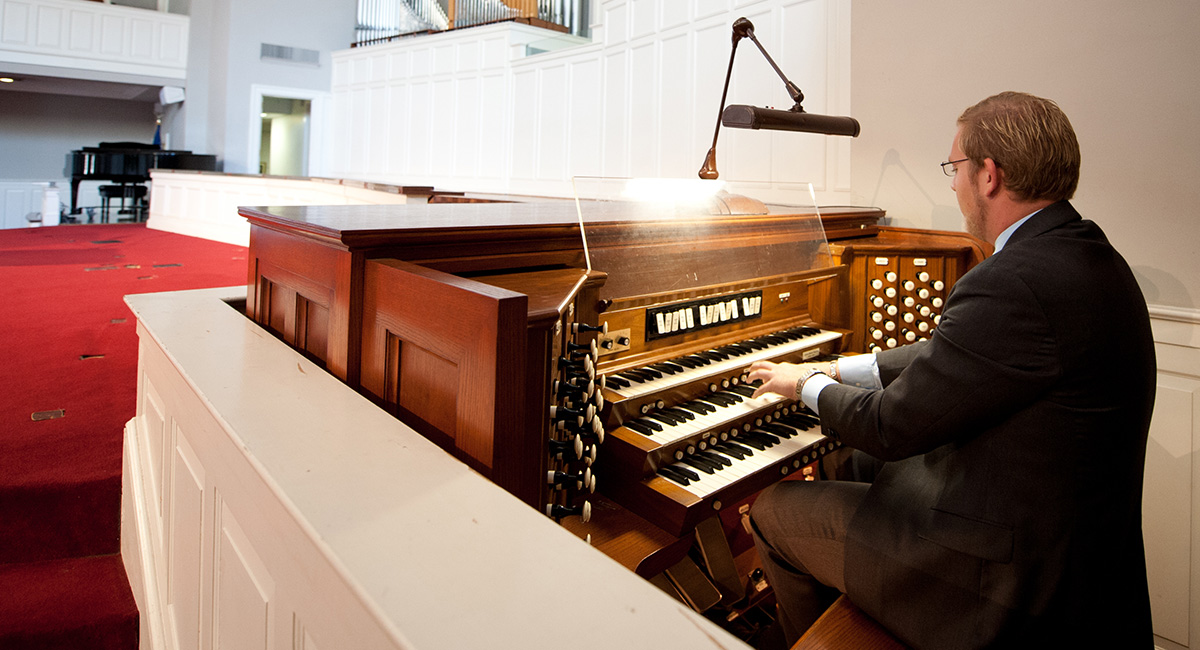
Why Study Church Music?
Students will have the opportunity to gain hands-on experience by doing supervised work in a church setting, become well-versed in church music history and techniques and learn from Belmont's expert faculty. This program is highly individualized to your needs and desired career path. Our hands-on faculty help mold the skills required for students to become a strong leader in the field.
What You'll Learn
- Music research tools, materials and techniques
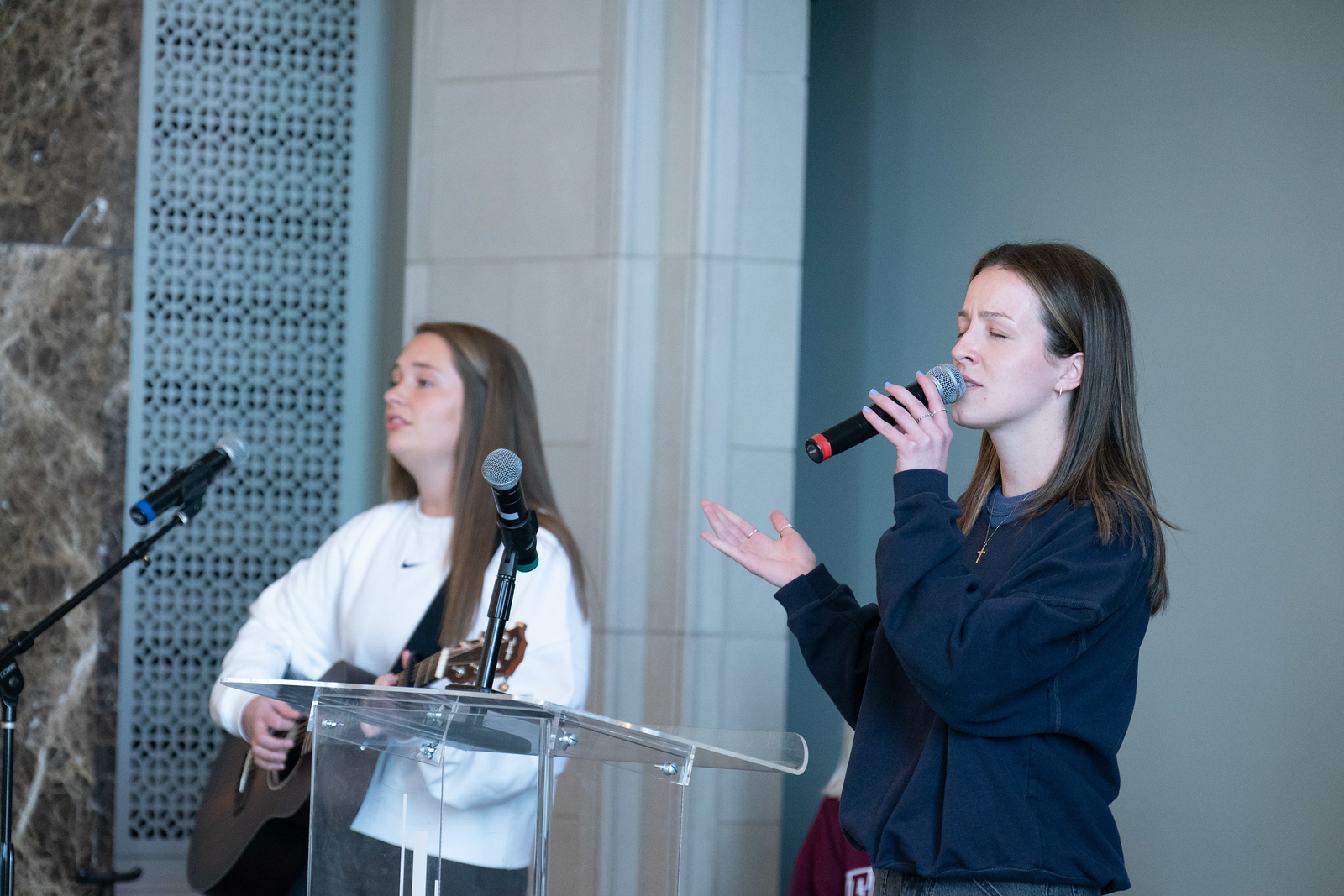
- Worship theology, history and practice
- Hymn history and use
- Leadership in a church music setting
- The philosophy and practice of church music
- Church music educationmethods and materials used to lead and teach various age groups
Career Possibilities
- Minister of Music for congregational worship
- Creator of new musical works for church services
- Serving in church leadership as coordinator of arts ministries
- Choirmaster
- Organist
- Children's choir leaders
- A combination of the roles above
Program Details
Courses You'll Take
Curious about your coursework? View requirements for this degree in the course catalog.
You'll have a variety of opportunities in Belmont's Master's of Music in Church Music program including:
- Participating in ensembles with other students passionate about music
- Performing in state-of-the-art performance halls
- Joining a thriving and creative musical community in Nashville and at Belmont
National Association of Schools of Music (NASM)
1. Apply to the University
- Create a BU4U account
- Complete the Belmont University Graduate Studies Application for Admission
- Pay the $50 Application Fee
2. Submit Supplemental Materials
Once your application is submitted and the application fee is paid, you will receive an email with instructions on how to submit the supplemental pieces of the application. You will be required to provide the following:
- Two completed recommendation forms from individuals who know the applicant's musical abilities. At least one recommendation must be completed by an individual who can address the applicant's accomplishments and potential in the academic classroom setting.
- A list of repertory studied in the principal performing area, including undergraduate junior and senior recital repertory, if applicable.
- A writing sample from undergraduate academic course work.
- Statement of Purpose. This one-page essay should describe why you are interested in the desired degree program and Belmont University, and address your personal and professional career goals.
- Official transcripts of all previous college and masters level work. International applicants with college level coursework from foreign institutions must have their transcripts evaluated by a credential evaluation service such as World Education Services ( wes.org). Applicants must have a minimum of a 3.0 cumulative GPA. Students who have earned below a 3.0 may be considered on a case-by-case basis.
3. Submit Prescreening Materials
In addition to the listed supplemental materials, all applicants are required to submit prescreening materials for their degree of choice. The materials you submit to Acceptd will be reviewed as your prescreen materials, and not your formal audition. An email will be sent with instructions for submitting these materials via our prescreening platform, Accept’d. The prescreening process is as follows:
- Submit the University application and pay the application fee; instructions are then sent detailing how to submit prescreening materials.
- Create an account via our prescreening platform, Accept’d,
- Upload required prescreening material by the deadline that corresponds with your intended audition date. Deadlines and requirements are listed below.
- If the prescreening is passed, register for a live audition date.
Video/audio editing, mixing, or re-mastering of any kind is not permitted for prescreening submissions. Any materials received that have been altered will result in an automatic denial.
Prescreening results will be released in rounds that correspond with the prescreening deadlines. Results may be released earlier, but are guaranteed to be released within two weeks of the deadline.
4. Audition for the School of Music
All applicants are required to audition for the School of Music. The audition day will consist of a live audition and interview with our faculty. The interview will also allow time for questions from attendees.
An audition registration email will be sent upon receipt of the application, all supplemental materials, and passing through the prescreening.
Prescreening Requirements:
Voice
- Include a video recording of two pieces representing two different languages, which should:
- Demonstrate the applicant's best work by highlighting musical ability and technical training.
- Demonstrate the applicant's knowledge of and potential for success in the program.
- A list of repertory studied in the principal performing area, including undergraduate junior and senior recital repertory, if applicable.
- A resume detailing additional experience that indicates the applicant is qualified to pursue the program.
Instrumental (Including Organ)
- Include a video recording of two contrasting pieces, which should:
- Demonstrate the applicant's best work by highlighting musical ability and technical training.
- Demonstrate the applicant's knowledge of and potential for success in the program.
- A list of repertory studied in the principal performing area, including undergraduate junior and senior recital repertory, if applicable.
- A resume detailing additional experience that indicates the applicant is qualified to pursue the program.
Piano
- Include a video recording of two contrasting pieces, which should:
- Demonstrate the applicant's best work by highlighting musical ability and technical training.
- Demonstrate the applicant's knowledge of and potential for success in the program.
- A list of repertory studied in the principal performing area, including undergraduate junior and senior recital repertory, if applicable.
- A resume detailing additional experience that indicates the applicant is qualified to pursue the program.
Conducting
Please note, students wishing to pursue conducting as their principal will need to submit a video prescreening, and upon passing, will have a virtual interview with a Graduate Conducting Faculty member. Students are not required to come to a live audition.
- Include 10-20 minutes of high-quality video. Applicants should include an excerpt from a rehearsal and a full performance of one selection.
- Demonstrate applicant’s best work by highlighting musical ability and technical training.
- A complete conducting repertoire list and dates of performances.
- Include “liner notes” detailing background information on the audio or video submitted.
Liner Notes Template
- Student Name
- Intended Major and Emphasis
- Principal Instrument
- The following details for each musical selection:
- Title
- Songwriter/Composer
- Your role in each recording (i.e composer, arranger, vocalist, producer, etc.)
- Date of recording
- Purpose of recording (i.e undergraduate recital, professional studio project, professional live performance, demo recording, newly recorded for this submission, etc.)
Audition Requirements:
Voice
- An art song in either of the following languages: French, German or Italian
- A 20th century art song in English
- An aria from the standard operatic or oratorio literature sung in the original language
Instrumental
- Two (2) works appropriate to the instrument that demonstrates two (2) distinctly different styles. This includes individual pieces, sonata or concerto movements.
-
Detailed audition expectations for percussion applicants are as follows:
- A four (4) mallet work for marimba by one of the following composers: Abe, Bach, Gomez, Helble, Musser, Rosauro, Smadbeck or Stout
- A three (3) or four (4) drum composition for timpani by one of the following composers: Beck, Bergamo, Carter, Firth, Goodman, Leonard, Peters or Whaley.
- An appropriate work for snare drum or multi-percussion. Appropriate works for snare drum would include those by such composers as Colgrass, Goldenberg, Hurley, Markivich, Pratt, Smith, Wilcoxon and Wooten; for multi-percussion, composers such as Cage, Cahn, Fink, Kraft, Tagawa and Whaley provide suitable repertoire from which to choose.
- Demonstrate scales and arpeggios on marimba, various rudiments for snare drum and tuning proficiency on timpani.
- Demonstrate a proficient knowledge of scales and arpeggios
- Applicants may substitute one music selection suitable for a service of worship for one of the repertoire pieces listed above
Piano
- A substantial Baroque work by a composer such as Bach, Handel or Scarlatti, OR a sonata movement by Beethoven, Haydn or Mozart
- A substantial work by a 19th century composer such as Brahms, Chopin, Liszt, Mendelssohn or Schumann; or a 20th century work or movement from a work by a composer such as Barber, Bartok, Copland, Debussy, Hindemith, Prokofiev or Ravel
- Demonstrate a proficient knowledge of scales, arpeggios and sight-reading
- Applicants may substitute one music selection suitable for a service of worship for one of the repertoire pieces listed above
Organ
- A work by J.S. Bach or other important Baroque composer for organ
- A 19th century work by a composer such as Franck or Mendelssohn
- A 20th century work by one of the following: Dupre, Hindemith, Langlais, Vierne or Widor
- Applicants may substitute one music selection suitable for a service of worship for one of the repertoire pieces listed above
All scholarships will be distributed based on the strength of the audition. All applicants are considered for scholarships.
Request Information
Contact Us
College of Music & Performing Arts
Angela Stenzel
Graduate Admissions Coordinator
(615) 460.8307
Email Angela